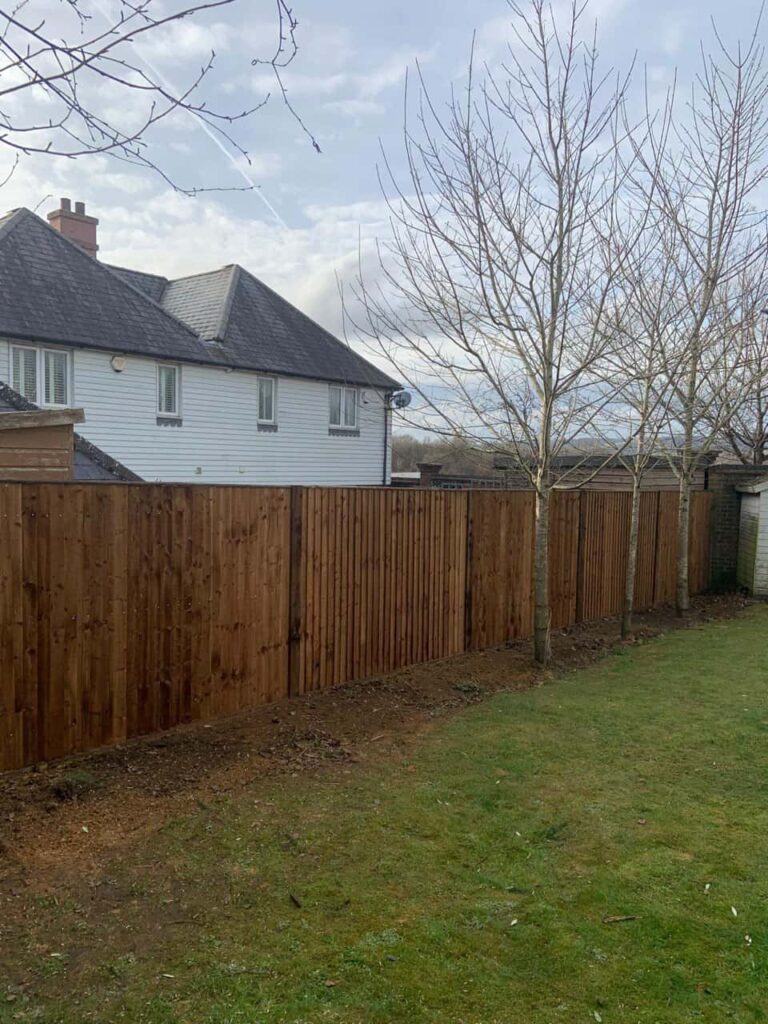
What Makes Feather Edge Fencing Suitable for Privacy and Secure Boundaries?
A boundary fence needs to do more than mark where one property ends and another begins. For many households, it must also provide privacy, discourage unwanted access and create a clear separation between different outdoor spaces.
Feather edge fencing is well suited to these requirements because it forms a solid, continuous barrier using overlapping vertical timber boards. For property owners in Waterbeach, Cambridge, it can provide a practical boundary that combines effective screening with a strong, traditional appearance.
Why Feather Edge Fencing Works Well for Defined Boundaries
Unlike fencing with open gaps between boards, feather edge construction creates a largely closed surface. Individual boards are fixed vertically to horizontal rails, with each board overlapping the next. When supported by properly installed posts and gravel boards, the result is a robust fence that can follow boundaries of varying lengths.
The fence must still be designed and installed correctly. Its performance depends on suitable materials, secure foundations and careful attention to the conditions around the property.
Overlapping Boards Provide Effective Privacy
The overlapping arrangement of feather edge boards restricts views through the fence. This makes the style particularly useful around rear gardens, seating areas and other spaces where privacy is important.
Because the boards are fitted individually, their overlap can be maintained along the full boundary. A well-constructed fence should not contain the wide gaps that can sometimes develop in lighter or poorly assembled fencing.
The height and position of the boundary also affect the degree of screening provided. These factors should be considered alongside the layout of the garden and nearby ground levels.
The Solid Construction Creates a Clear Barrier
Feather edge fencing forms a substantial physical boundary. Its close-boarded design helps define private areas and can discourage casual access more effectively than decorative fencing with wide openings.
A secure fence relies on more than the boards themselves. Strong posts, correctly positioned rails and dependable fixings all contribute to the stability of the structure.
Gates should also be considered as part of the complete boundary. A sturdy fence cannot provide consistent separation if its access points are weak, poorly aligned or difficult to secure.
Individual Boards Form a Strong Structure
Each feather edge board is tapered, allowing it to overlap the adjacent board without creating excessive thickness. The boards are fixed to rails that distribute support across the fence.
This construction creates a unified surface rather than relying on a single lightweight panel. If one board becomes damaged, it may also be possible to replace that section without disturbing the entire fence line.
The quality of the timber and fixings remains important. Boards that are too thin, insufficiently overlapped or poorly secured may move, split or create gaps.
Posts and Foundations Support the Entire Fence
Fence posts carry the pressure placed on the boundary by its own weight and by windy conditions. If they are inadequately spaced, poorly installed or already deteriorating, the fence may lean even when the boards remain in good condition.
Professional installation considers:
- the length and height of the fence
- ground firmness and changes in level
- suitable post spacing
- the number and position of rails
- likely wind exposure
- gates and access points
- adjoining paths, planting and garden features
These details help ensure that the complete structure works as one stable boundary.
Gravel Boards Help Protect the Timber
Direct and prolonged contact with damp soil can cause the bottom of timber fencing to deteriorate prematurely. Gravel boards create separation between the feather edge boards and the ground.
They also form a neat lower edge and can help retain small differences in surface level. Where the ground slopes, the fence may be stepped or adjusted carefully so that privacy is maintained without leaving large gaps underneath.
Gravel boards do not remove the need for routine inspection, but they can protect the most vulnerable lower section of the fencing.
Feather Edge Fencing Can Follow Uneven Ground
Gardens are not always level, and rigid prefabricated panels may leave awkward gaps where the ground rises or falls. As feather edge fencing is assembled from individual components, it can be adapted more precisely to the boundary.
This flexibility is useful where the fence line crosses gradual slopes or changes direction. Careful setting-out allows the finished structure to maintain a consistent appearance while following the site.
Accurate installation is particularly important in these situations. Poor alignment can make the fence look uneven and may create weak or exposed sections.
The Appearance Suits Different Garden Settings
Feather edge fencing has a simple, traditional appearance that works with a wide range of garden layouts. Its vertical boards create a tidy background for planting, lawns, patios and other outdoor features.
The fence can also be finished with capping to protect and define its upper edge. Consistent board spacing, straight rails and properly aligned posts make a considerable difference to the overall result.
A fence intended for privacy should still complement the property rather than appear unnecessarily imposing.
Maintenance Helps Preserve the Boundary
Even a well-built timber fence benefits from periodic inspection. Small issues are generally easier to address before they affect neighbouring components.
Points worth checking include:
- loose or damaged boards
- movement around posts
- deteriorating rails
- gaps developing between boards
- damaged capping
- vegetation pressing against the fence
- moisture collecting around the base
Early repairs can help prevent one weak section from placing additional strain on the surrounding fence.
When Feather Edge Fencing May Be Particularly Suitable
Feather edge fencing can be a practical choice where a property requires:
- greater screening from nearby viewpoints
- a clearly defined garden boundary
- a continuous barrier without open gaps
- fencing that follows an irregular boundary
- individual components that can be repaired separately
- a traditional timber finish
The final design should reflect the location, ground conditions and intended purpose of the boundary.
Conclusion
Feather edge fencing is suitable for privacy and secure boundaries because its overlapping boards create a strong, largely closed surface. When combined with correctly installed posts, rails, fixings and gravel boards, it can provide dependable separation and effective screening.
Its performance depends on the quality of the complete installation rather than the boards alone. Proper planning ensures that the fence follows the ground accurately, withstands everyday exposure and fits the surrounding garden.
If you are considering feather edge fencing for a property in Waterbeach, Cambridge, Fast Fix Fencing Waterbeach can assess the boundary and recommend a suitable design. Contact our team to discuss your fencing requirements and arrange a professional evaluation.
Call us on: 01223 912 296
Click here to find out more about Fast Fix Fencing Waterbeach
Click here to complete our contact form and see how we can help with your fencing needs.